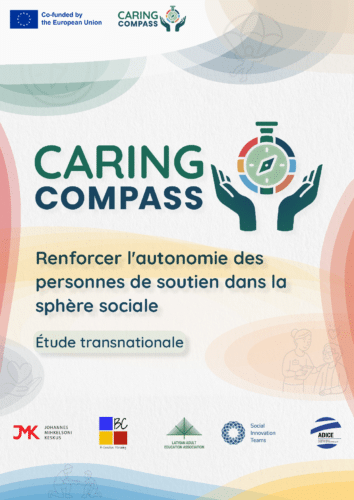

Handbook: Providing better support for those working in social care
Download
Introduction
Produced as part of the European Erasmus+ Caring Compass project, this handbook draws on a transnational study to provide a clear and practical methodological framework. Its aim is to help structure, manage and ensure the success of social support and integration programmes
Objectives
Designed as a comprehensive reference guide, this handbook aims to:
- Professionalise individual support by equipping practitioners with tried-and-tested methods.
- Ensure sound practice within organisations by providing an ethical, clear and sustainable organisational framework.
- Prevent burnout through a precise definition of each practitioner’s roles and professional stance.
Structure and content
The handbook is divided into two complementary parts:
Part I: Practical guide for support workers (Approaches and procedures):
- A clear definition of the role and professional boundaries (what the support worker does and does not do).
- Communication techniques, self-regulation and conducting interviews.
- Tools for setting realistic objectives and encouraging the beneficiary’s independence.
- Digital ethics, confidentiality and data protection.
Part II: Handbook for organisations and service providers:
- Framework and added value: positioning support as a complement to existing social and employment services.
- Role and risk management: distribution of responsibilities within the team and setting professional boundaries.
- Recruitment and induction: value-based selection criteria and procedures for welcoming support workers.
- Organisation of work: the service user’s journey, matchmaking (based on shared attitudes and values), agreements and arrangements for meetings.
- Team support and wellbeing: establishing supervision, co-vision (peer support) and burnout prevention.
- Networking, quality and sustainability: working in partnership, gathering feedback, protecting service users’ rights and funding models.
Target audience
This resource is primarily intended for:
- Managers of organisations, project coordinators and team leaders in the social, medico-social and voluntary sectors, or within local authorities.
- Field-based support workers, mentors, peer supporters and volunteers involved in one-to-one support relationships.
- Professionals in the fields of employment, rehabilitation and social integration wishing to set up a mentoring or tutoring framework.
Note on use
The two parts of the handbook have been designed to be used in tandem (for example, during joint training sessions for coordinators and support workers). The chapters can be consulted independently depending on the maturity of the service: at the start to define roles, or during the project to adjust supervision and quality management.